What is a Safety Management System: Understanding the Basics in a World of AI
Benefits, Limitations of Traditional EHS Platforms, and the Impact on AI Analysis
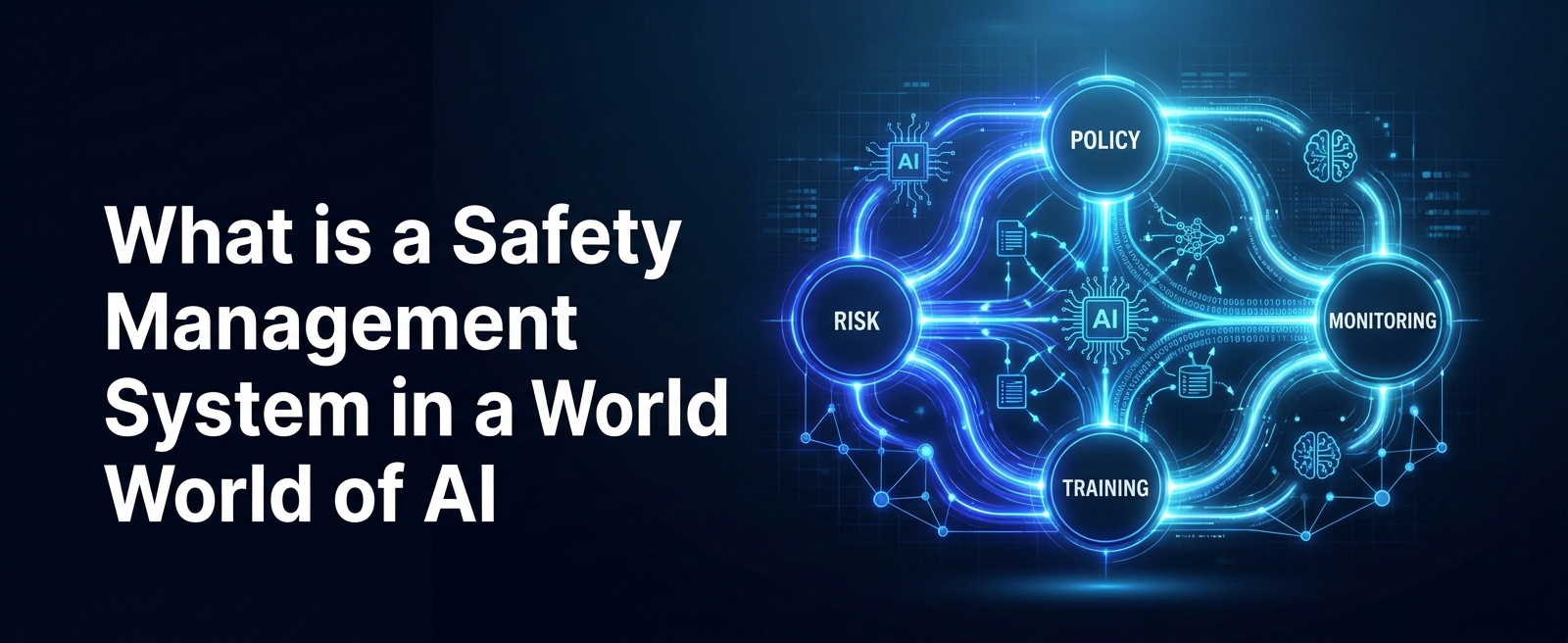
A Safety Management System (SMS) is intended to provide a systematic, proactive approach to managing safety risks and improving workplace safety performance. This systematic approach highlights the structured nature of SMS — a management framework that provides structured processes for identifying, assessing, and controlling safety risks in the workplace.
In theory, an SMS enables organizations to identify hazards, assess risks, implement controls, and continuously improve safety outcomes. In practice, however, most organizations experience their SMS through EHS software platforms that translate these principles into forms, workflows, and databases. This translation introduces a critical problem: while SMS principles are sound, the way safety data is captured and structured often undermines both human decision-making and AI-driven analysis.
As artificial intelligence becomes increasingly embedded in safety management, the limitations of traditional EHS platforms are no longer just an efficiency issue. They are a data quality and epistemic problem that directly affects the reliability of AI outputs.
The Core Promise of Safety Management Systems
A well-implemented SMS helps organizations:
Reduce workplace incidents and injuries
Improve compliance with regulatory requirements
Enhance operational efficiency
Build a positive safety culture
Enable data-driven safety decision-making
Most SMS frameworks are built around similar principles: hazard identification, risk assessment, mitigation planning, incident investigation, and continuous improvement through audits and reviews. These principles form the operational backbone of modern workplace safety.
How Organizations Actually Use SMS: The EHS Platform Reality
In real-world deployment, SMS is not an abstract framework — it's a software interface. Organizations purchase EHS platforms like Intelex, Cority, Enablon, or Gensuite, and these systems become the operational face of their Safety Management System.
These platforms offer dashboards, incident reporting modules, compliance tracking tools, risk matrices, and corrective action workflows. In theory, these tools should enable seamless SMS execution. In practice, they introduce several structural problems.
Data Fragmentation
Safety data is scattered across incident reports, risk assessments, audit checklists, training records, and maintenance logs. Each module operates semi-independently, making it difficult to see relationships between events.
Rigid Data Entry
Most EHS platforms force users into drop-down menus, pre-defined categories, and rigid forms. Nuanced safety observations get reduced to checkboxes. Context and detail are lost.
Poor Searchability
Finding historical incidents related to a specific hazard often requires navigating multiple screens, filters, and exports. Safety teams struggle to extract actionable insights from their own data.
Over-Reliance on Lagging Indicators
Traditional SMS metrics focus on incidents that already happened — TRIR, DART, lost-time injuries. Leading indicators (near misses, observations, proactive risk assessments) are harder to track and analyze.
Traditional SMS platforms were not designed with AI readiness in mind. They were built for compliance reporting and workflow management, not for machine learning or predictive analytics.
Why This Matters for AI: The Data Quality Problem
As organizations adopt AI-driven safety tools — predictive analytics, natural language processing for incident reports, risk prediction models — they face a sobering reality: AI can only be as good as the data it's trained on.
Traditional EHS platforms introduce several data quality issues that directly undermine AI performance:
1. Inconsistent Categorization
Different users classify the same incident differently. A 'slip' might be tagged as 'walking surface,' 'housekeeping,' or 'PPE failure' depending on who enters the data. AI models trained on this data will produce inconsistent predictions.
2. Sparse or Missing Context
Rigid form fields mean that rich contextual information is never captured. An AI trying to predict the likelihood of a fall incident may miss critical factors like weather, shift timing, or maintenance history — simply because the EHS platform didn't ask for that information.
3. Lack of Narrative Data
The most valuable safety insights often come from free-text descriptions — but traditional EHS platforms don't structure this text in a way that makes it usable for AI. Natural language processing models require clean, well-labeled text data to work effectively.
4. Siloed Data Sources
Safety data lives in one system, maintenance logs in another, operational metrics in a third. AI models need integrated, cross-functional data to identify patterns — but most organizations can't easily link these systems.
The Future: AI-First Safety Management
The next generation of Safety Management Systems will be fundamentally different. Instead of forcing safety data into rigid forms and drop-downs, AI-first platforms will:
Capture Rich, Contextual Data
Use natural language interfaces that allow safety professionals to describe incidents, hazards, and near misses in their own words. AI models can then extract structured insights from unstructured text.
Integrate Data Across Systems
Connect safety data with maintenance logs, operational metrics, environmental sensors, and HR records to provide a holistic view of risk.
Automate Pattern Recognition
Use machine learning to identify recurring risk factors, predict incident likelihood, and recommend targeted interventions before incidents occur.
Prioritize Leading Indicators
Shift focus from lagging metrics (incidents that happened) to leading indicators (conditions that increase risk). AI can analyze near misses, behavioral observations, and environmental factors to predict where incidents are likely to occur.
Enable Real-Time Decision Support
Provide safety managers with AI-powered insights at the point of decision, helping them prioritize interventions, allocate resources, and prevent incidents before they happen.
Conclusion: Rethinking SMS for the AI Era
Safety Management Systems have evolved significantly over the past decades, moving from paper-based compliance programs to digital platforms. But the next evolution — AI-first safety management — requires rethinking how we capture, structure, and analyze safety data.
The limitations of traditional EHS platforms are no longer acceptable in a world where AI can predict incidents, identify hidden patterns, and provide real-time decision support. Organizations that continue to rely on rigid, fragmented, and poorly structured safety data will fall behind those that embrace AI-ready safety management systems.